How to Smoke the Perfect Brisket on a Charcoal Grill
Complete guide to smoking brisket on a charcoal grill.
What Is Brisket and Why It's Considered the Peak of BBQ
Brisket is the pectoral muscle of the cow, one of the most challenging yet most flavorful cuts for grilling. In Israel, this cut is called brisket (בריסקט) and is available in most meat departments.
The secret of brisket lies in its abundant collagen and connective tissue. Quick cooking makes the meat tough. But with slow cooking (8-12 hours at low temperature), collagen converts to gelatin, making the meat incredibly tender and juicy. According to research by AmazingRibs.com, collagen breakdown begins at 71°C and accelerates at 82°C, which is why low-and-slow is the only way to tenderize this cut.
Brisket consists of two parts:
| Part | Name | Characteristic | Notes |
|---|---|---|---|
| Flat | The flat portion (flet in Israel) | Lean, uniform thickness | Easier to slice, dries out faster |
| Point | The thick portion (point in Israel) | Fatty, abundant marbling | Juicier, ideal for burnt ends |
For smoking, use a Whole Packer brisket with both parts, weighing 4-6 kg.
How to Choose Brisket at the Store
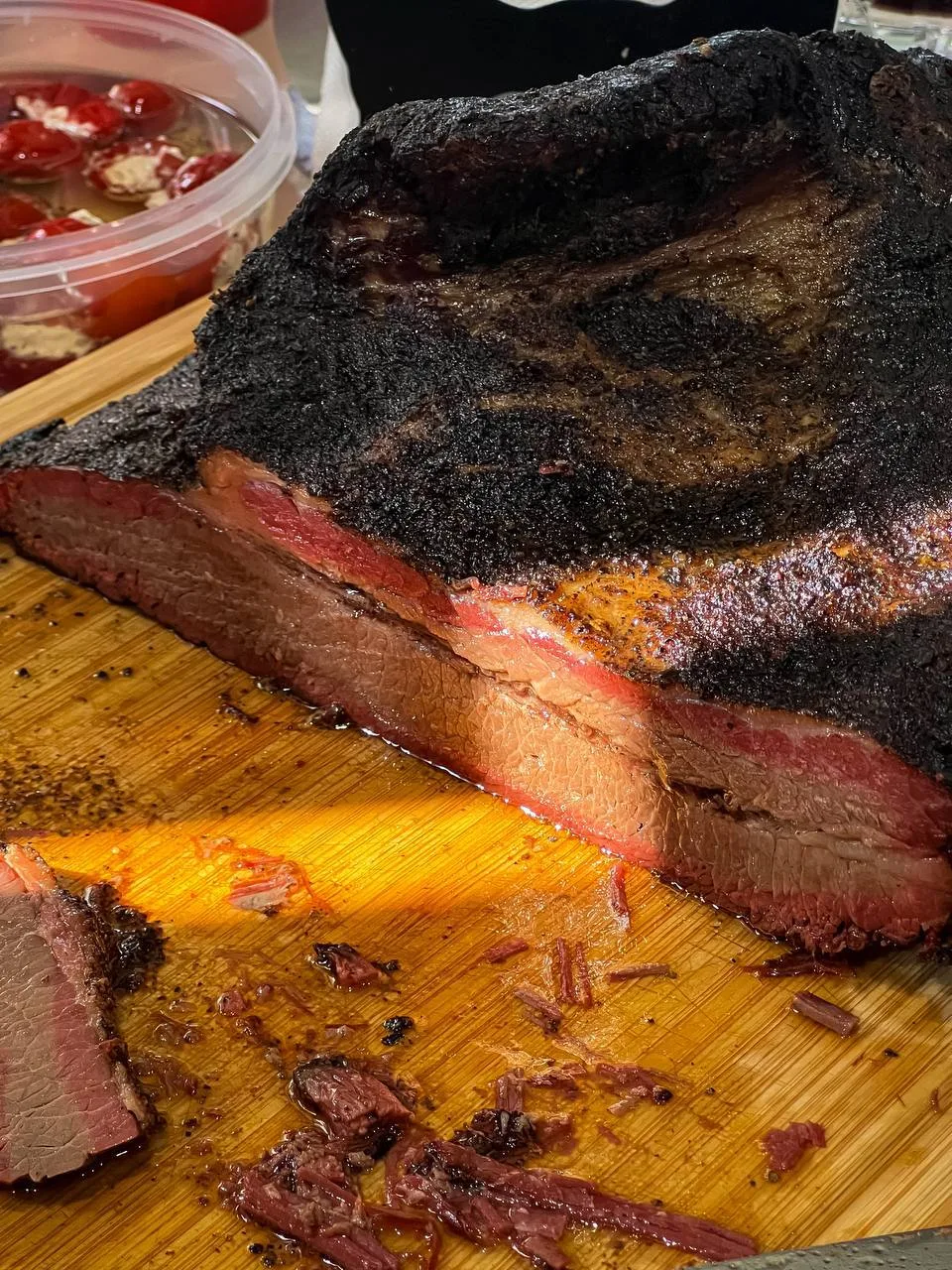
Choosing the right meat is half the battle. Here's what to look for:
- Weight: 4-6 kg (whole). Too small will dry out, too large won't fit a standard grill
- Marbling: look for white fat streaks within the muscle. More marbling means juicier results
- Fat Cap: an even layer of fat on top, 1-2 cm thick
- Flexibility: hold the brisket in the middle. A good piece bends gently under its own weight
- Color: deep red, with no gray or brown spots
In Israeli supermarkets, brisket is sold both whole and pre-separated into Flat and Point. For smoking, always buy whole.
Preparation: Trimming and Rub
Trimming
Proper trimming is a critical step. You'll need a long, sharp knife:
- Flip the brisket Fat Cap down. Remove all hard fat chunks and silver skin from the bottom
- Flip back over. Trim the Fat Cap to 0.5 cm thickness. Too thick won't let smoke through, too thin and the meat dries out
- Round off the corners — thin edges will burn during long cooking
Rub
The classic Texas rub — simple and effective:
| Ingredient | Ratio | Purpose |
|---|---|---|
| Coarse salt | 50% | Flavor + draws moisture for bark |
| Coarse black pepper | 50% | Aroma + bark foundation |
| Garlic powder | To taste | Depth of flavor |
| Smoked paprika | To taste | Color and subtle sweetness |
Apply the rub generously on all sides 30-60 minutes before starting. You can coat the meat with mustard first — it acts as a binder for the spices and disappears completely during smoking.
Setting Up the Grill for Smoking
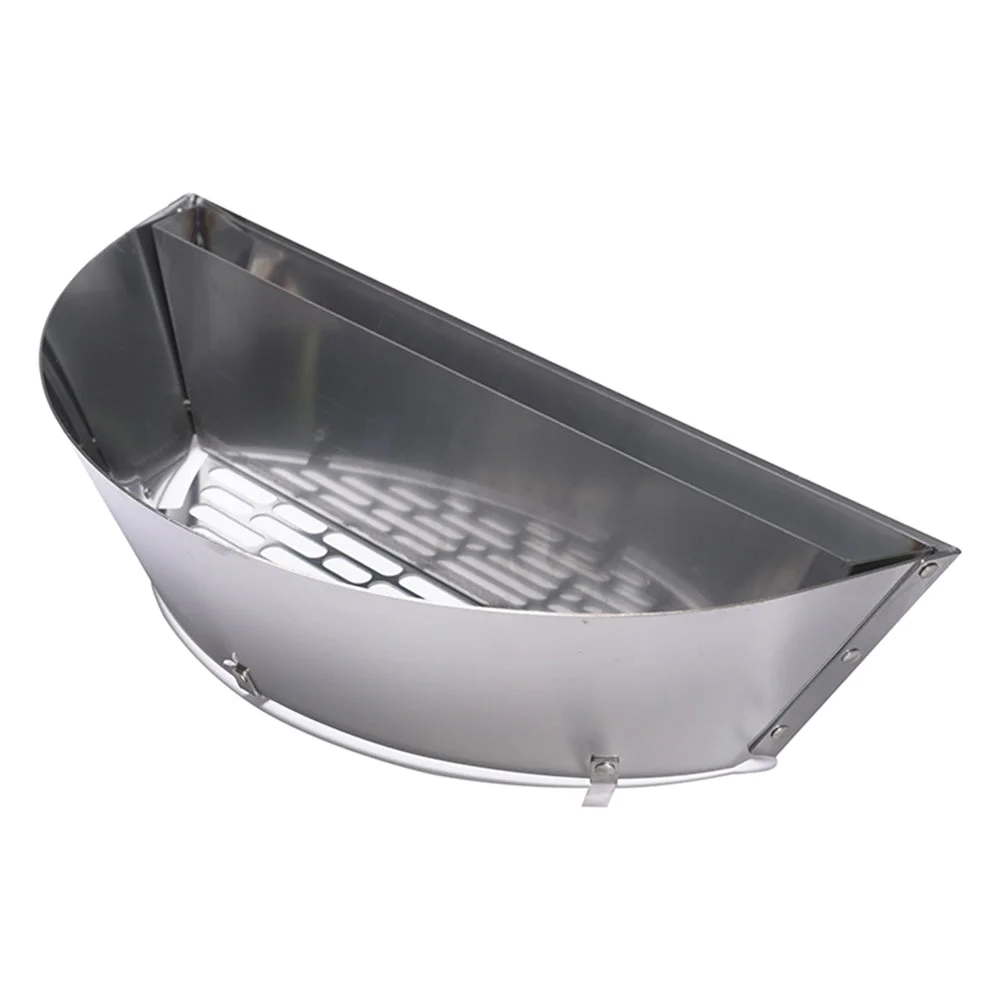
Brisket needs stable low heat for 8-12 hours. Here's how to set it up with Slow 'N Sear:
- Fill the Slow 'N Sear with unlit charcoal to the top
- Light 15-20 briquettes separately (in a chimney starter) and place on top — this is the Minion Method
- Add 2-3 chunks of smoking wood between the coals
- Fill the Slow 'N Sear water reservoir with hot water
- Close the lid and wait for the temperature to stabilize
The two-zone cooking method is the foundation of smoking: coals and heat on one side, meat on the other.
Target Temperatures
| Parameter | Temperature | Note |
|---|---|---|
| Grill temperature | 107°C | Stable throughout the entire process |
| The Stall | 65-71°C | Meat temperature stops rising |
| Doneness | 95-96°C | Internal meat temperature |
| Serving | 60-65°C | After resting, ideal for slicing |
The doneness temperature of 95-96°C (203-205°F) has been confirmed by years of testing at AmazingRibs.com — at this temperature, collagen fully breaks down while the meat retains its juiciness. For more on temperature control, see our complete grilling temperatures guide.
Choosing Smoking Wood
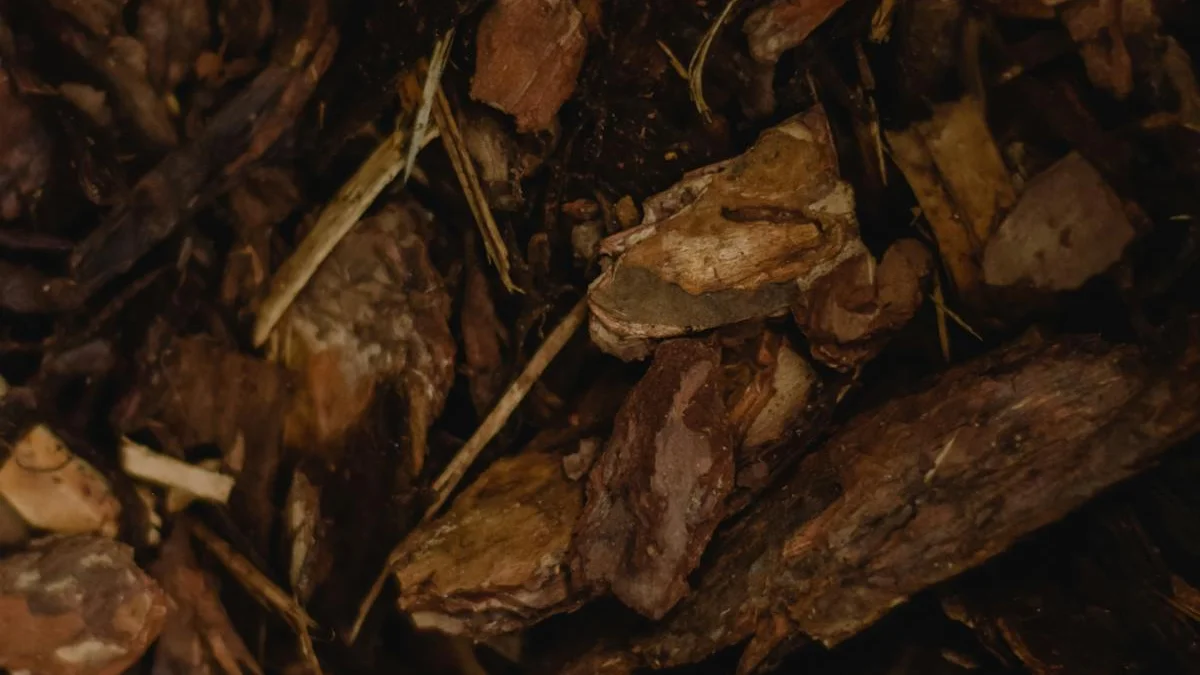
Wood determines the smoke flavor. The best options for brisket:
| Wood | Intensity | Flavor Profile | Recommendation |
|---|---|---|---|
| Oak | Medium | Classic, clean smoky flavor | Best choice for beginners |
| Pecan | Medium | Mild, slightly sweet | Excellent for balanced flavor |
| Cherry | Light | Fruity, beautiful bark color | Great mixed with oak |
| Hickory | Strong | Rich, bacon-like | Use in moderation |
| Mesquite | Very strong | Aggressive, can turn bitter | Not recommended for long smoking |
According to professional smoking guides, oak and pecan are considered universal woods for beef. For more details on wood selection, read our article Smoking Wood Chips: How to Choose.
The Smoking Process: Step-by-Step Guide
Phase 1: Smoke Absorption (0-3 hours)
Place the brisket Fat Cap up on the grate, above the water reservoir (indirect heat). In the first 3 hours:
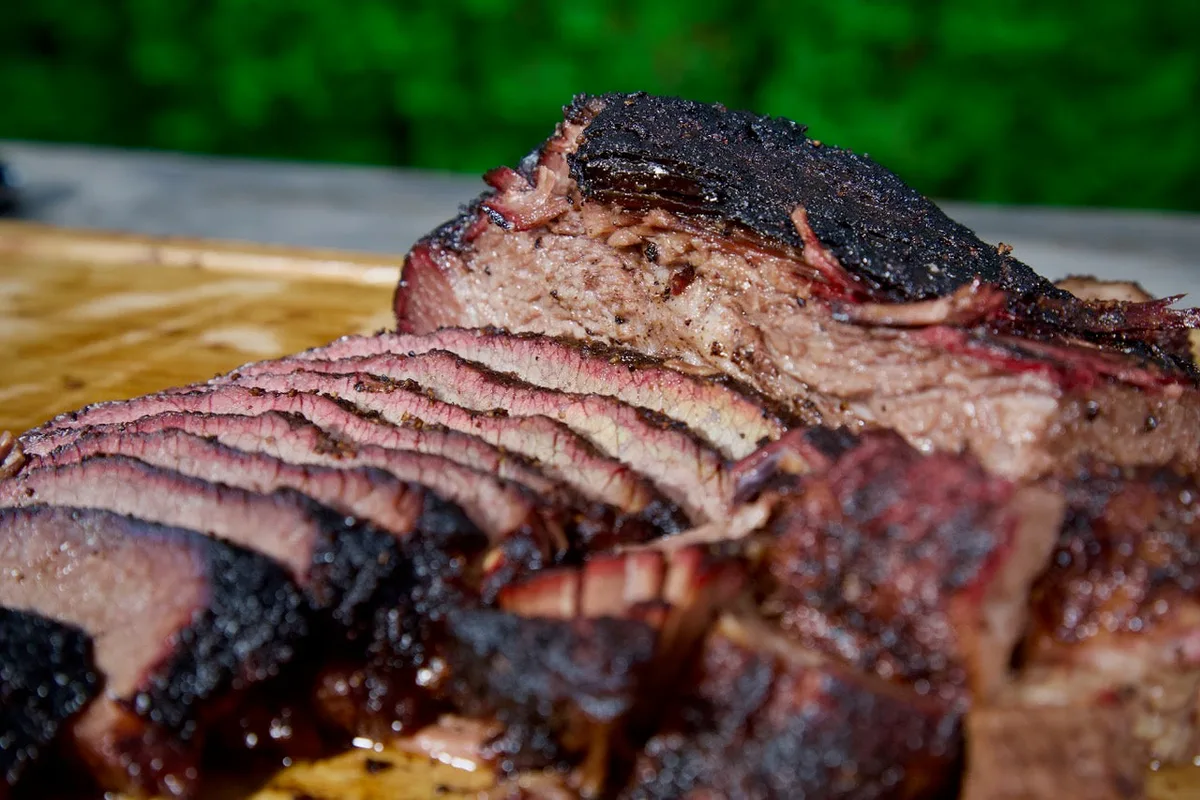
- The Bark forms — a dark, aromatic crust made of spices, smoke, and meat
- The meat actively absorbs smoke. This is when the smoke ring forms — a pink layer beneath the surface. As explained by experts at AmazingRibs.com, the smoke ring forms through the reaction of nitric oxide (NO) from smoke with myoglobin in the meat
- Don't open the lid unnecessarily. Each opening costs 15-20 minutes
- The chimney should produce Thin Blue Smoke. White billowy smoke is bad — it will make the meat bitter
Phase 2: The Stall and Texas Crutch (3-6 hours)
At an internal temperature of 65-71°C, the meat "stalls" — the temperature stops rising. This is The Stall, and it can last for hours. According to the scientific analysis at AmazingRibs.com, the cause is evaporative cooling: moisture escapes to the surface and cools the meat, similar to sweating.
The solution — Texas Crutch: tightly wrap the brisket in butcher paper. This speeds up the stall while preserving the bark. Butcher paper is better than foil — it breathes and doesn't soften the crust.
Phase 3: The Final Push (6-10+ hours)
After wrapping, the meat temperature rises faster. Target — 95-96°C internal temperature. Total time:
- Estimate: 1-1.5 hours per kilogram
- A 5 kg brisket = approximately 8-12 hours
- Start early in the morning (or overnight) — it's better to finish early and let the meat rest longer
How to Tell When It's Done
Temperature is a guide, but not the only criterion. Use the Probe Tender Test:
- Insert a probe into the thickest part of the Flat
- The probe should slide in like warm butter — with almost no resistance
- Lift the brisket on the probe — the meat should bend gently under its own weight
If the probe meets resistance — the meat isn't ready, even if the temperature is "correct." Return it to the grill. Remember: according to USDA standards, the minimum safe temperature for beef is 63°C — brisket at 95°C exceeds this threshold significantly.
Resting — The Most Important Step
Many skip this step, and it shows. During resting, juices redistribute throughout the meat, resulting in a significantly juicier outcome.
- Minimum: 1 hour
- Optimal: 2-4 hours
- How: wrap the brisket in butcher paper, then a towel, and place in an empty cooler (not cold!)
- The meat will maintain serving temperature (60-65°C) for several hours
Slicing Brisket
Proper slicing is just as important as the cooking:
- Find the grain direction — it runs differently in the Flat and Point
- Always slice against the grain — this is critical for texture
- Slice thickness — 6-7 mm (pencil thickness)
- Use a long, sharp knife. Cut with one confident motion, don't "saw"
Common Mistakes and How to Avoid Them
| Problem | Cause | Solution |
|---|---|---|
| Dry meat | Overcooking or insufficient rest | Pull at 95°C, rest at least 1 hour |
| Tough meat | Undercooking (collagen didn't break down) | Return to grill, wait for Probe Tender Test |
| Bitter taste | White billowy smoke, wet wood | Use dry wood, ensure airflow. More details — smoke science at AmazingRibs.com |
| No bark | Too humid or wrapped too early | Don't wrap before 65°C internal temp |
| Temperature spikes | Uncontrolled ventilation | Close bottom vent, don't open lid |
More smoking tips in our complete meat smoking guide.